
How Dispensaries Can Turn World Cup Traffic into Measurable Growth with NXTeck
April 5, 2026
Q2 Reality Check. Did Your Q1 Growth Actually Stick?
May 10, 2026How Dispensaries Can Turn World Cup Traffic into Measurable Growth with NXTeck
April 5, 2026Q2 Reality Check. Did Your Q1 Growth Actually Stick?
May 10, 2026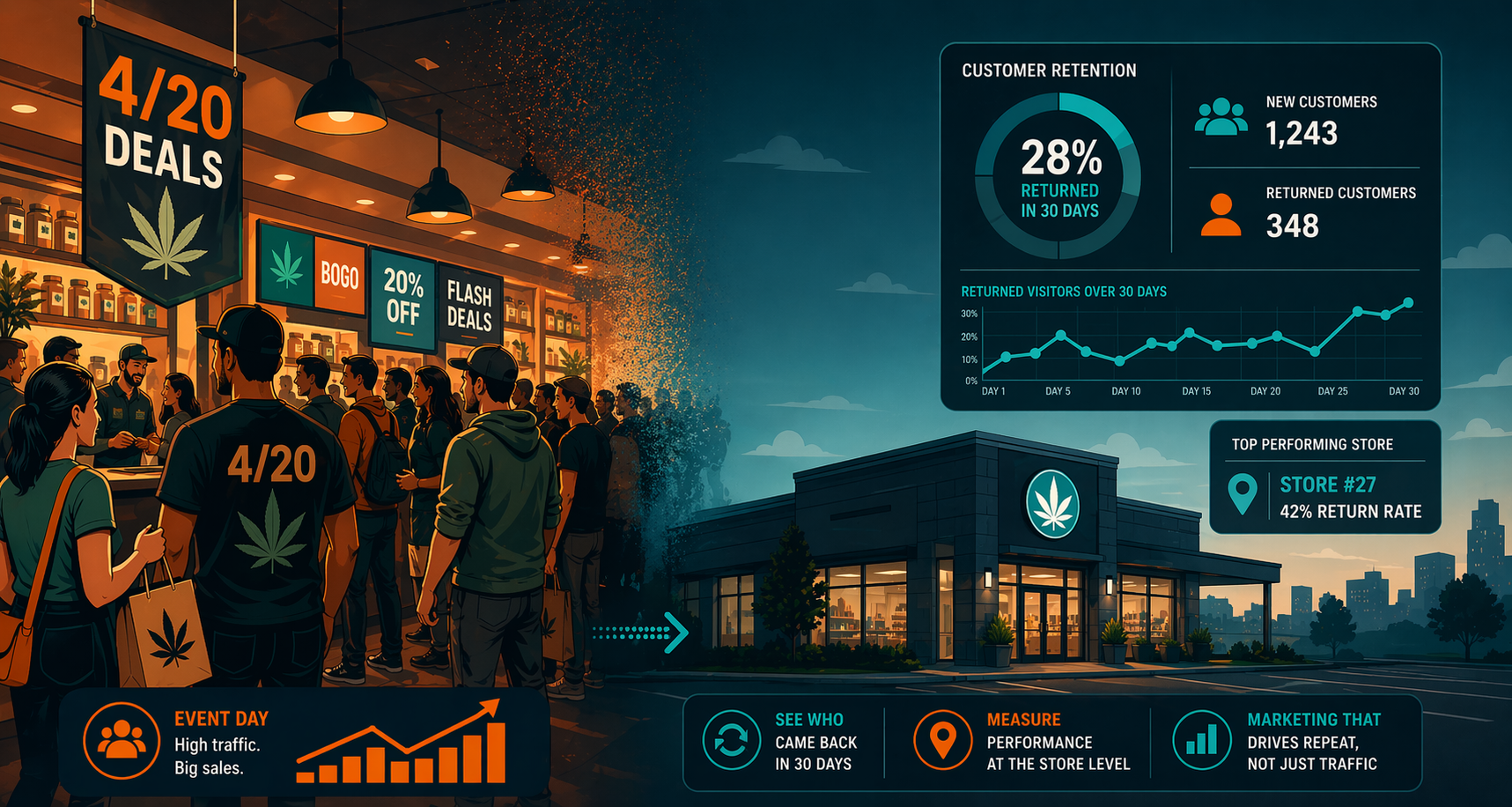
Every year, 4/20 delivers what retailers expect: packed stores, elevated traffic, strong daily sales, and a rush of promotional activity. For many operators, it becomes one of the biggest revenue days of the year.
But once the discounts end and traffic normalizes, the real performance story begins.
Because high-volume days can be misleading.
A crowded store does not automatically mean customer growth. Strong one-day revenue does not always translate into long-term value. Many brands celebrate the sales spike without knowing whether they actually gained profitable new customers or simply discounted to existing ones.
Most brands won’t know if they grew their customer base until it’s too late to fix it.
That is the difference between seasonal demand and sustainable growth.
The smartest operators use 4/20 as an acquisition opportunity, not just a sales event. They ask harder questions after the holiday:
- How many first-time customers visited during 4/20 week?
- How many returned within 30 days?
- What was their average spend after the promotion ended?
- Which locations retained the most new shoppers?
- Which media channels drove repeat customers, not just traffic?
- How much of the lift came from existing customers who would have purchased anyway?
These answers matter more than the one-day sales total.
We have seen this play out in real campaigns. In one 90-day retail engagement, a brand generated a 9x return on ad spend while increasing online orders by 38% and foot traffic by 62%. In another multi-month campaign, $59,891 in spend drove more than $508,000 in attributed revenue with an 8.5x ROI.
That is what happens when growth is measured beyond a single promotional day.
If a campaign drove thousands in revenue but those shoppers never return, the long-term value may be limited. In similar campaigns, we’ve seen 40%+ of 4/20 “new customers” never return without targeted re-engagement.
But if even a portion of those first-time visitors become repeat monthly customers, the true ROI of 4/20 can be significantly higher than the event-day numbers suggest.
This is where better measurement changes strategy.
NXTeck helps brands connect marketing to verified visits, new customer acquisition, repeat behavior, and store-level revenue. We show you exactly which 4/20 visitors came back in 30 days and which didn’t, at the store level.
Instead of guessing which promotions worked, operators can see which efforts created lasting value and which simply rented traffic for a weekend.
Because the goal of 4/20 should not be one busy day.
It should be a stronger May, a stronger Q2, and a larger loyal customer base heading into the rest of the year.
Drive revenue. Prove revenue.