
The World Cup Is Coming. But Will Those Visitors Ever Return?
June 7, 2026
The Fireworks Are Over. Now Measure What Actually Happened.
July 5, 2026The World Cup Is Coming. But Will Those Visitors Ever Return?
June 7, 2026The Fireworks Are Over. Now Measure What Actually Happened.
July 5, 2026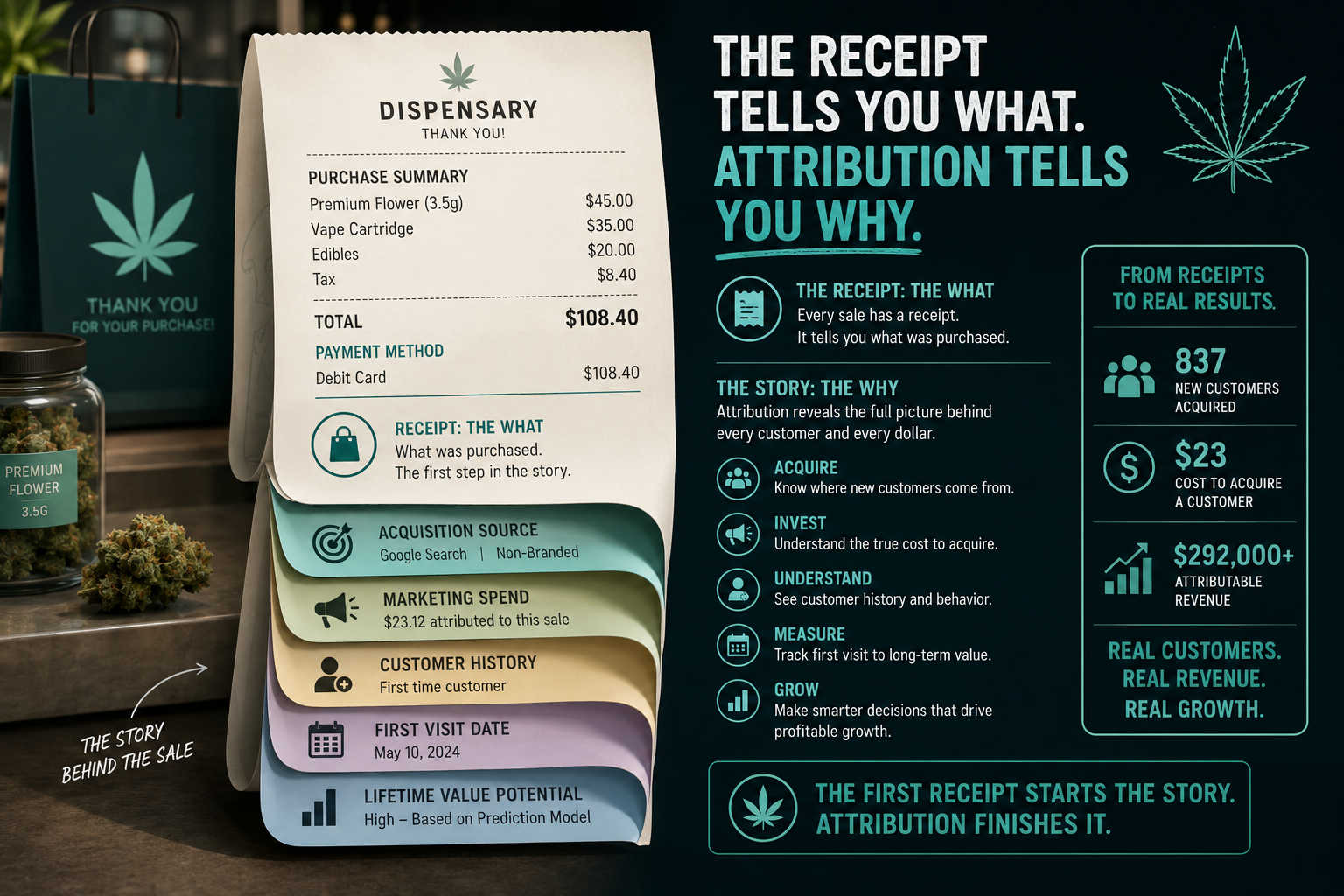
Most dispensary operators believe customer acquisition is becoming more expensive.
They’re right.
Advertising restrictions continue to limit available channels. Competition is increasing in nearly every legal market. New stores are opening, consumers have more choices than ever, and marketing budgets are under greater pressure to prove results.
Across the cannabis industry, operators are being asked to grow revenue while demonstrating exactly which marketing investments are producing measurable returns.
Yet there is another challenge hiding beneath rising media costs.
Many dispensaries still don’t know what it actually costs them to acquire a new customer.
Recently, a dispensary campaign generated more than $292,000 in attributable revenue from approximately $19,000 in marketing spend. The campaign also produced more than 2,500 verified store visits, over 1,400 online transactions, and 837 verified new customers.
The most important number wasn’t the revenue.
It was the customer acquisition cost.
At approximately $23 per new customer, the operator gained something many dispensaries still struggle to calculate with confidence: a defensible understanding of what it actually cost to create a new customer relationship.
That may sound like a basic business metric. In reality, it’s one of the most difficult numbers in cannabis retail to measure accurately.
Most operators can tell you how much they spent on advertising. They can tell you how many impressions were served, how many clicks occurred, how many loyalty signups were generated, and how many online orders were placed.
What many cannot confidently answer is a much more important question:
How many genuinely new customers did those marketing investments create?
That distinction matters because customer acquisition cost isn’t simply a marketing metric. It’s the foundation for understanding profitability.
A dispensary cannot accurately evaluate marketing performance without understanding what it paid to acquire a customer. It cannot properly assess lifetime value, retention performance, or return on marketing investment without first establishing that baseline.
The challenge is that many acquisition calculations are based on activity rather than customer outcomes.
A consumer may see a display ad, browse a menu, receive a text message, interact with a loyalty program, and eventually visit the store. Multiple platforms may claim credit for that purchase. Every reporting dashboard reports success.
But none of those systems necessarily answer the most important question:
Did the dispensary acquire a new customer?
That question becomes increasingly important as markets mature.
A campaign may generate thousands of clicks. It may produce strong online ordering activity. It may even increase store traffic.
But if a large percentage of those transactions come from existing customers who would have purchased anyway, the true acquisition cost may be far higher than reported.
This is where many dispensaries unintentionally create a disconnect between marketing performance and business performance.
They become highly effective at measuring activity while remaining less certain about customer creation.
The operator that acquired 837 verified customers for approximately $23 each approached the problem differently.
Rather than focusing solely on impressions, clicks, or online orders, the campaign focused on customer acquisition and attributable revenue. The result was more than $292,000 in measurable revenue, over 2,500 verified store visits, and a clear understanding of how many new customers entered the business.
That visibility changes how operators evaluate growth.
Customer acquisition cost alone doesn’t prove profitability. It provides the starting point. Once a dispensary understands what it paid to acquire a customer, it can compare that cost against average basket size, repeat purchase behavior, customer lifetime value, and long-term revenue contribution.
That is ultimately the question every dispensary executive is trying to answer.
Not whether impressions increased.
Not whether clicks improved.
Not whether a platform dashboard reported success.
The real question is whether the customers acquired justify the investment required to acquire them.
As customer acquisition costs continue to rise across cannabis retail, the operators gaining the greatest advantage are not necessarily the ones finding cheaper media.
They’re the ones gaining a clearer understanding of customer economics.
They know what they paid to acquire a customer.
They know what those customers generated in revenue.
They know whether those customers returned.
And they know which marketing investments are creating long-term value rather than short-term activity.
The hidden cost of customer acquisition isn’t simply the rising price of advertising.
It’s the cost of making growth decisions without knowing what customer acquisition actually costs in the first place.