
Why Foot Traffic Attribution Matters for Dispensaries in Q1
January 18, 2026
You Found the Gaps. Now What? Turning Competitive Insight Into Action for Dispensaries
February 15, 2026Why Foot Traffic Attribution Matters for Dispensaries in Q1
January 18, 2026You Found the Gaps. Now What? Turning Competitive Insight Into Action for Dispensaries
February 15, 2026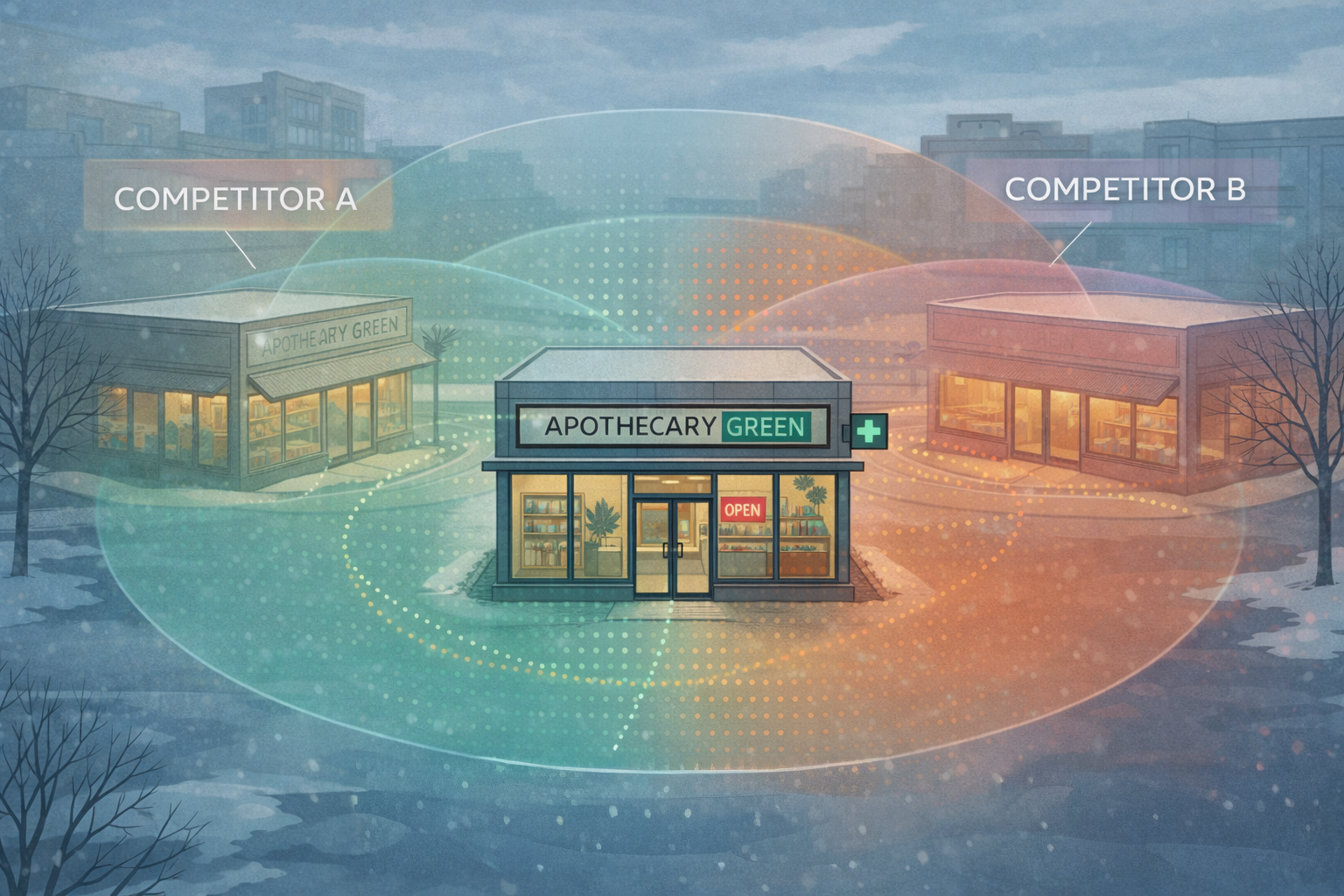
At some point, every growing dispensary asks the same question:
“Who are our competitors?”
It sounds strategic. It feels foundational. And yet, for many dispensaries, even well-established, high-performing ones, it is the wrong place to start.
Because the reality is this:
cannabis consumers are not making decisions based on competitor lists. They are making choices in the real world, trip by trip, visit by visit, moment by moment.
And unless you can see those choices, you are operating with blind spots that no amount of promotion, discounting, or campaign optimization can fix.
Competitors Aren’t Who You Think They Are
In theory, dispensary competition is easy to define. It is the other licensed operators in your trade area, often grouped by brand, size, or menu depth.
In practice, competition is defined by consumer behavior, not licenses or branding.
A cannabis consumer deciding where to shop is not comparing mission statements or store aesthetics. They are choosing based on proximity, convenience, timing, habit, product availability, and where they have already shopped recently.
This is why some of the most impactful competitors do not always show up in traditional analyses, and why even sophisticated operators are often surprised when asked simple but revealing questions:
- Which dispensaries do our customers visit instead of us?
- Where are we consistently losing foot traffic?
- Which nearby stores are quietly gaining share?
- How does competition change by store location, time of day, or shopper type?
If you cannot answer those questions with confidence, you do not have a marketing problem. You have a visibility problem.
Market Share in Cannabis Is Not a Static Metric
Market share in cannabis is often discussed at a high level, by state, by operator, or by banner. But in reality, it is the sum of thousands of individual shopping decisions made every day.
In most legal markets, dispensaries operate in dense, highly competitive environments. New stores open. Promotions rotate. Consumer preferences shift. What looks like stable performance at the portfolio level can hide meaningful losses at the store or trade-area level.
Share is won and lost:
- Store by store
- Daypart by daypart
- Against competitors that may not look like direct rivals on paper
Without visibility into where cannabis consumers are actually shopping, operators are left investing blindly, unsure whether their efforts are protecting share, growing share, or simply maintaining the status quo.
The Gap Most Dispensaries Do Not See Until It Is Costly
Most dispensary operators are deeply familiar with their own data. They know their sales trends, basket sizes, loyalty participation, and promotional performance.
What they often lack is external context.
They do not see:
- How frequently their shoppers visit competing dispensaries
- Which nearby stores capture the most customer overlap
- Where spend fails to disrupt competitor shopping behavior
- Which trade areas are vulnerable and which are primed for conquest
This is not a failure of strategy. It is a limitation of traditional cannabis data, which is overwhelmingly inward-facing.
And it is exactly the gap NXTeck was built to fill.
How NXTeck Turns Competitive Guesswork Into Clarity for Dispensaries
NXTeck does not ask dispensaries to guess who their competitors are.
We show them.
By analyzing aggregated, privacy-safe real-world visitation data, NXTeck reveals:
- Which dispensaries consumers actually choose instead of yours
- How often those competitive visits occur
- Where competitive pressure is strongest by store and trade area
- Which competitors are gaining or losing share over time
This is not modeled data or survey-based assumptions. It is observed behavior, grounded in where cannabis consumers actually go.
For dispensary operators, that means:
- No more relying on assumed competitive sets
- No more evaluating performance in isolation
- No more guessing where share is being lost
Instead, you gain a clear picture of your true competitive landscape, one that changes by location, consumer segment, and moment.
From “Who Are Our Competitors?” to “Where Are We Losing and Why?”
The most sophisticated dispensaries are no longer asking who they compete with.
They are asking:
- Where are we underperforming at the store level?
- Which dispensaries are intercepting our shoppers?
- What would it take to win those visits back?
- How should we allocate spend based on real behavior, not assumptions?
NXTeck enables that shift from static thinking to dynamic insight.
Because when you understand how cannabis consumers actually move between stores, decision-making stops being reactive. It becomes precise.
The Dispensaries That Win See the Whole Field
Growth in cannabis does not stall because operators lack ambition or effort. It stalls when they cannot see what is happening beyond their own four walls.
Competitive clarity is not about naming rivals.
It is about understanding choice.
And the dispensaries that win next are the ones that stop asking who they think their competitors are and start measuring where their customers actually shop.
That is the difference between guessing and knowing.
That is the difference NXTeck delivers.